

Reading the Room – The Science of Social Awareness at Work
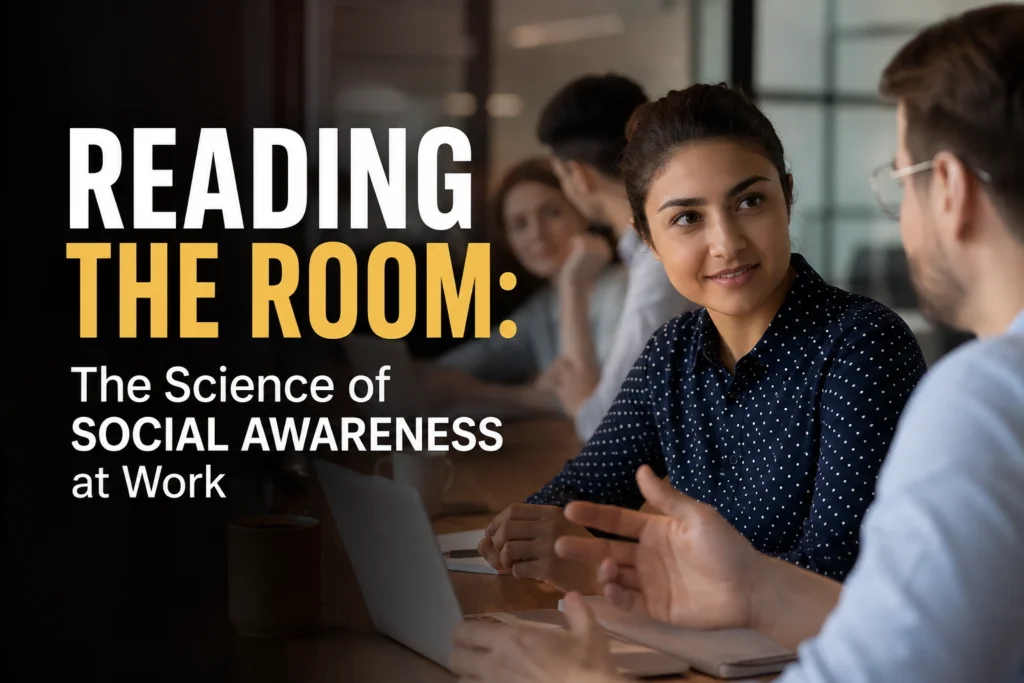
A colleague once told me about the exact moment she knew a project was doomed. It wasn’t in the status report. It was three minutes into a kickoff meeting, when the sponsor said “this all sounds great” while his arms were crossed and his eyes were on the door. Nobody else in the room seemed to notice. She did, and she was right. That’s social awareness. Not emotional intelligence in the abstract, but the specific, trainable skill of reading what’s actually happening in a room, versus what’s being said out loud. And it might be the most underrated skill in the workplace, no matter your title.
The Skill Hiding in Plain Sight
Daniel Goleman’s original model of emotional intelligence names social awareness as one of four core domains, alongside self-awareness, self-management, and relationship management. But of the four, it’s the one that gets the least attention in workplace training, probably because it’s the hardest to put a checklist around.
Self-awareness, you can journal your way toward. Self-management, you can practice with a breathing technique. But social awareness asks something harder: that you temporarily set your own perspective aside and accurately perceive someone else’s, their mood, their motives, the unspoken tension between what they’re saying and what they mean.
Psychologists call this “empathic accuracy”: the ability to correctly infer another person’s thoughts and feelings in real time. And research on it reveals something uncomfortable: most of us are far worse at it than we think, and confidence in our own read of the room is only weakly related to how accurate that read actually is.
The Three Channels Worth Watching

- Tone before words. What’s the energy in someone’s voice before you process what they’re saying? A flat “sure, sounds good” carries different information than an enthusiastic one – and most people register the flatness on some level even when they can’t name why.
- Body before face. Faces are easy to control; posture and hands are not. Crossed arms, a chair angled toward the door, hands that go still- these often leak what a carefully composed expression is hiding.
- Silence and sequencing. Who speaks first, who speaks last, who doesn’t speak at all, and who everyone glances at before answering- the shape of a conversation often carries more information than its content.
The Bottom Line
Technical skill gets you in the room, at any level. Social awareness is what tells you what’s actually happening once you’re there – whether the meeting that looked fine on paper is quietly falling apart, and whether the “sounds good” from a peer, a manager, or a new hire two seats down actually means what it says. It’s not a soft skill reserved for people who manage others. It’s a perceptual one, and like any perceptual skill, it sharpens with deliberate, repeated attention regardless of what’s on your business card.
The next time you walk into a meeting, try reading the room before you try to run it. What you notice in the first three minutes will usually tell you more than anything said in the next thirty.
Leave a Reply