

The Four Domains of Emotional Intelligence

Ask ten people to define emotional intelligence and nine will say some version of “being good with feelings” or “staying calm under pressure.” Both are true, and both miss the point. EI isn’t one skill. It’s four distinct ones, and most people are strong in one or two and quietly weak in the other two without ever realizing which.
Daniel Goleman’s original framework, built on decades of research, organizes emotional intelligence along two simple questions: whose emotions are you working with, yours or someone else’s, and what are you doing with them – noticing them or acting on them? Cross those two questions and you get four domains, not one blurry concept.
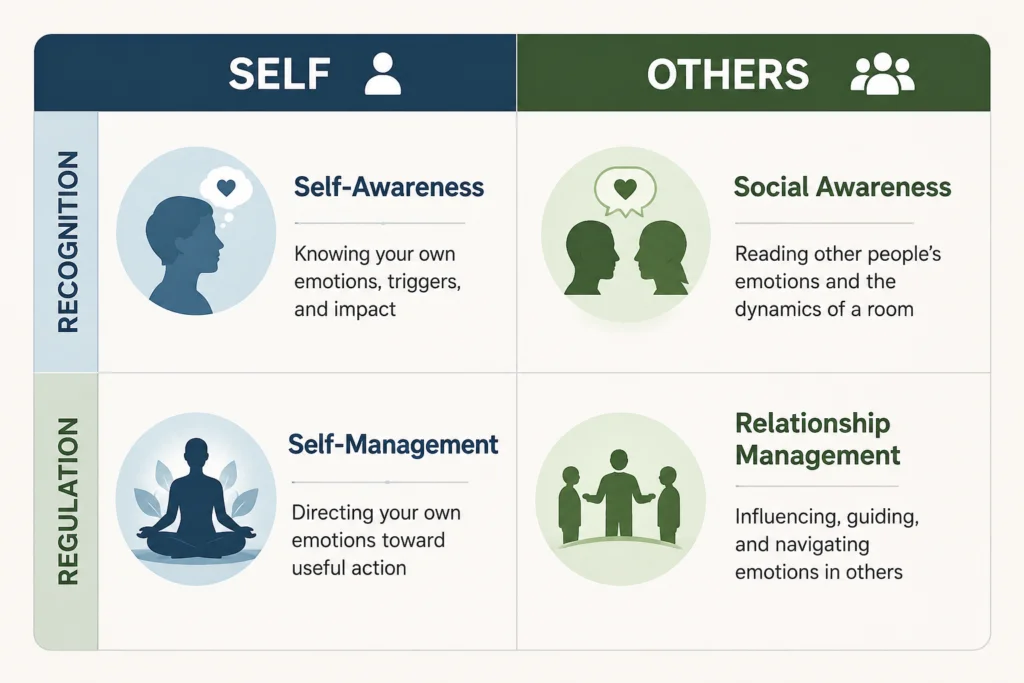
Self-Awareness: Knowing What’s Actually Happening in You
This is the starting point, and the one most people overrate in themselves. Self-awareness isn’t just knowing you’re stressed; it’s knowing why, recognizing the early physical signs before they show up in your tone of voice, and understanding which situations reliably trigger which reactions in you.
The gap here is usually not insight; it’s timing. Most people can explain their reaction after the fact. Far fewer catch it while it’s happening, which is the only moment it’s actually useful.
Try this:
Once a day, name your emotional state in one word before you react to anything not after.
Self-Management: Doing Something Useful With What You Feel
Self-management gets mistaken for suppression, staying quiet, staying calm, not showing anything. It’s the opposite. It’s choosing your response instead of defaulting to your first impulse: the sharp reply, the withdrawal, the email sent at 11 p.m. that could have waited until morning. The skill isn’t feeling less. It’s building a gap between the feeling and the action — even a few seconds is often enough.
Try this:
Before sending a reactive message, save it as a draft and reread it after twenty minutes.
Social Awareness: Reading What’s Happening Around You
This is the domain of picking up on someone else’s mood, motives, and the unspoken tension in a conversation, tone before words, body before face, what’s left unsaid. It’s the one that gets the least formal training, probably because it’s the hardest to teach from a slide.
It matters at every level, not just for people managing others. A junior teammate who senses a colleague is overwhelmed, and a new hire who reads that a “quick call” is actually urgent, are both exercising this domain just as much as anyone with a title.
Try this:
In your next meeting, spend the first thirty seconds only observing tone, posture, who’s engaged before you say anything.
Relationship Management: Turning Awareness Into Action With Others
This is where the first three domains combine and get tested in real time: navigating a disagreement, giving feedback someone doesn’t want to hear, building trust with someone who doesn’t yet have a reason to extend it. It’s the most visible domain, which is why it’s often mistaken for the whole of emotional intelligence, when really it’s what the other three make possible.
Try this:
The next time you need to raise something difficult with a colleague, open by naming the shared goal before naming the problem.
Why the Framework Matters More Than the Buzzword
Most Emotional intelligence advice treats it as one dial to turn up. The four-domain view is more useful precisely because it’s less flattering: it forces you to ask which quadrant you actually operate from by default, and which one you skip. Someone can be highly self-aware and still poor at relationship management. Someone else can read a room brilliantly and still struggle to manage their own reaction once they’re in it.
“So the next time someone asks you to define emotional intelligence, don’t reach for the one-word version. Ask instead which quadrant you’re standing in right now and which one you’ve been avoiding. Emotional intelligence isn’t a trait you have or don’t. It’s four separate muscles. You already know which domain feels hardest for you. That discomfort isn’t a flaw in your character, it’s the most useful data point you have”.
Leave a Reply