

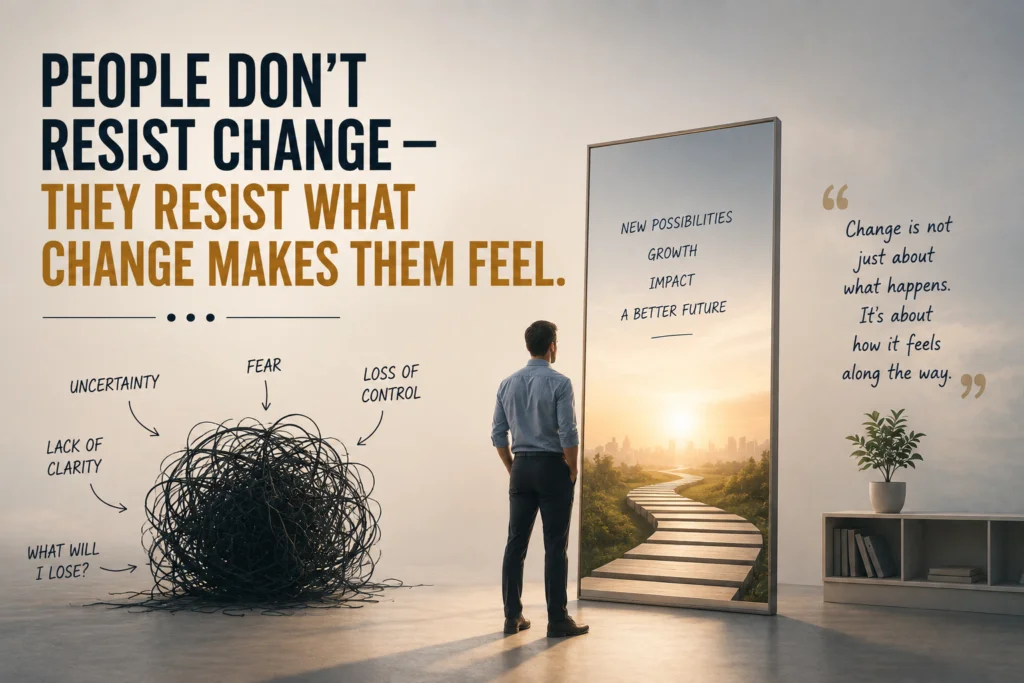
Change is rarely experienced as a process alone. It is experienced through uncertainty, emotion, trust, and what people believe they may gain or lose. Change is constant in organisations. Systems change. Structures evolve. Responsibilities shift. Leaders change. New ways of working are introduced. And when employees hesitate, question, or struggle, we often give it a simple label: “Resistance to change.”
But what if the resistance isn’t really about the change?
What if it is about what the change represents to the person experiencing it?
Behind Resistance, There Is Often Something Else
A new system → Will I still be competent?
A restructuring → Is my position secure?
A new manager → Can I trust this person?
A different responsibility → Can I succeed at this?
A new way of working → What am I losing?
What looks like resistance on the surface may actually be uncertainty, fear, loss of control, lack of trust, or simply a need for clarity. When we label all these reactions as resistance, we risk trying to correct the behaviour before understanding what is driving it.
The Question Behind the Questions
Organisations often respond to uncertainty with more communication – emails, presentations, town halls, FAQs, and explanations about why the change is necessary. All of that matters. But employees can understand why the organisation needs to change and still have one very human question: “What does this mean for me?”
Change becomes particularly difficult when it feels like something is being done to people rather than experienced with them. Of course, not every organisational decision can be collaborative. Leaders sometimes need to make difficult decisions quickly. But giving people a voice doesn’t mean giving everyone decision-making authority. Sometimes it simply means listening, creating space for questions, explaining the reasoning, acknowledging concerns, and being transparent about what is — and isn’t — known.
And Then There Is Trust
The same change can create completely different reactions depending on something that existed long before the change arrived: trust. When employees trust their leaders, uncertainty can still be uncomfortable, but there is greater confidence that decisions are being made thoughtfully and communicated honestly. When trust is already weak, even a sensible change can be met with suspicion.
Change management doesn’t begin when change is announced. It begins with the credibility leaders build long before change becomes necessary. Successful change is not simply about implementing a new system, structure, technology, policy, or process. It is also about helping people understand what the change means, what it asks of them, and how they can move through it.
A Final Thought
People do not always resist moving forward. Sometimes they are trying to understand what they are leaving behind, what lies ahead, and whether they feel equipped and supported to get there.
What have you seen labelled as “resistance to change” that was actually something else? Share your perspective in the comments; I’d be interested to hear what you’ve observed in practice.
Leave a Reply