

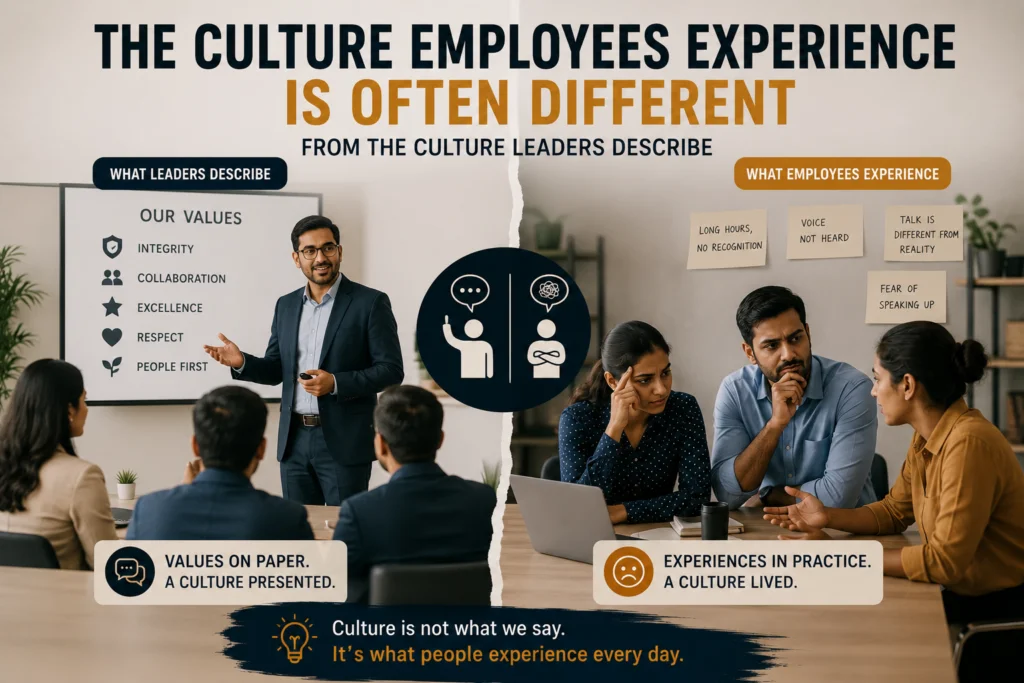
Culture is not defined only by the values written on a wall. It is shaped by what people experience every day.
Most organisations can describe the culture they want to create. Integrity. Respect. Collaboration. Accountability. Innovation. People First.
These values may appear in presentations, policies, induction programmes, websites, and office walls. But employees rarely judge culture by what an organisation says it values. They experience it through everyday behaviour. How leaders respond when someone makes a mistake. Whether employees can disagree without consequences. How decisions are explained. Who gets recognised. What behaviour gets overlooked. Whether managers listen. Whether commitments are followed through. This is where the difference between stated culture and experienced culture begins.
Culture Is Built in Everyday Moments
Culture can sometimes feel like a large organisational concept, but much of it is created through surprisingly small interactions.
A company may say it values open communication, but what happens when an employee challenges an idea?
It may promote collaboration, but are teams rewarded for working together or only for individual results?
It may speak about wellbeing, but do leaders consistently glorify overwork?
It may encourage innovation, but how are people treated when an idea fails?
It may describe itself as people-first, but do employees feel heard when difficult decisions affect them?
The answers to these questions tell us far more about culture than the words themselves.
Employees learn what an organisation truly values by observing what happens around them.
The Manager Often Becomes the Culture
For many employees, their immediate manager is their closest experience of the organisation. While policies may be created centrally, values shaped by leadership, and frameworks developed by HR, managers often determine what these things feel like in practice. One manager may create an environment where people feel trusted, respected, challenged, and supported, while another working within the same organisation can create an entirely different experience. This means there may not be one employee experience of culture; different teams can experience very different versions of the same company. That is why developing managers is an essential part of building culture, because ultimately, managers are one of the ways culture becomes visible.
Closing the Gap
Creating a strong culture does not necessarily require more values, campaigns, or statements. Sometimes it requires looking more closely at whether existing values are visible in everyday behaviour.
If we say respect, what does respect look like during disagreement?
If we say accountability, does it apply at every level?
If we say learning, are people allowed to make mistakes and improve?
If we say collaboration, do our systems and leaders actually encourage it?
If we say people matter, where can employees see evidence of that?
Culture becomes credible when what organisations say aligns with what people actually experience. Ultimately, culture is not defined by stated values, but by how consistently those values are lived, reinforced, and experienced every day.
Where do you think the biggest gap between stated culture and experienced culture usually appears? I’d be interested to hear what you’ve observed in the workplace.
Leave a Reply